
Quick answer
USDT, also called Tether, is a stablecoin: a crypto token designed to stay worth 1 US dollar. The company Tether issues it and backs it with reserves, $191.5 billion on 30 September 2026, mostly short-term US Treasury bills. About half of all USDT moves on Tron (TRC-20) and most of the rest on Ethereum (ERC-20). It is not a bank deposit, and Tether can freeze it at any address.








This guide works through the questions underneath. What really backs the coin, whether it can lose its peg, which chain to use, what each transfer costs and where Europe's 2026 rules leave it.
The reserve figures come from Tether's report for 30 September 2026, and every fee is worked out with real numbers.
What is USDT, in plain words?
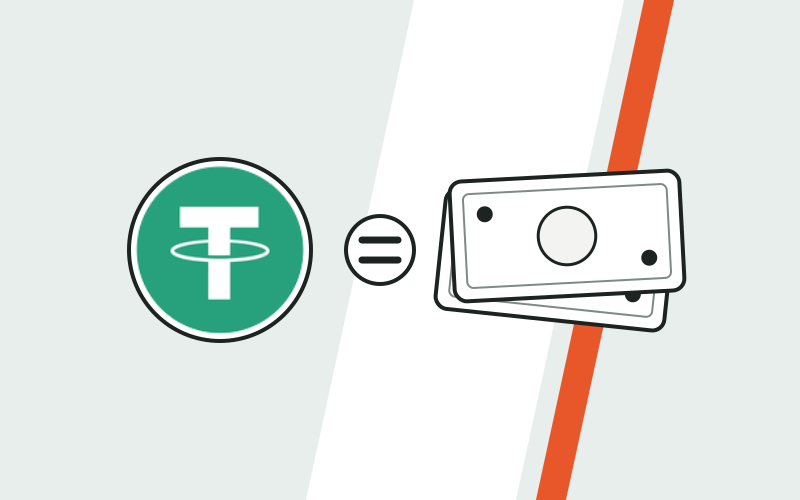
USDT is a digital dollar that moves over public blockchains. Tether, the company behind it, creates new tokens when large customers deposit dollars and destroys them when those dollars are paid back.
Bitcoin and Ether are free to rise and fall. USDT is designed to stay put. That makes it handy as a parking spot between trades, a way to get paid from abroad, and a dollar balance in countries where the local currency keeps losing value.
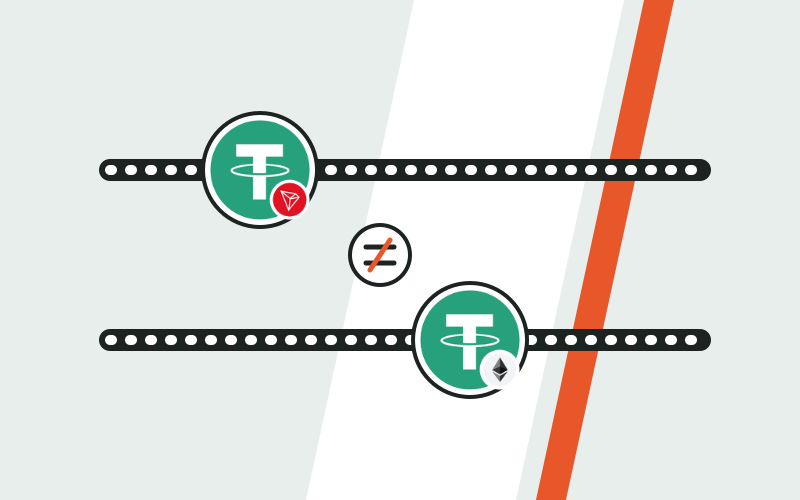
Here's the detail that catches people out: there is no single USDT network. The same token exists separately on Tron, Ethereum, Solana and others, and a token on one chain cannot hop to another by itself.
So every transfer, on any chain, runs the same way:
What actually backs USDT?
Tether says each USDT is covered by reserves worth at least as much. Its latest report shows $191.5 billion of assets against $183.5 billion owed on 30 September 2026, a cushion of about $7.95 billion.
What Tether held on 30 September 2026, in billions of US dollars
- US Treasury bills$122.8B
- Overnight repos backed by Treasuries$9.6B
- Physical gold$19.1B
- Secured loans$14.2B
- Bitcoin$8.4B
- Everything else in the report$17.4B
- Total reserves$191.5B
Count the Treasury bills and the Treasury-backed repos together and about 69% of the reserves are short-term US government debt. That part is about as close to cash as an investment gets.
$132.4 billion of short-term US government debt, the core of the reserves.
About $27.5 billion together, roughly 14%. Both can drop in price.
$14.2 billion lent out by Tether against collateral.
$7.95 billion more in assets than tokens owed, about 4.3% extra.
Attestation or audit?
For years the only check was a quarterly attestation from the accounting firm BDO: a look at the reserves on one specific day. In August 2026 something new arrived.
KPMG US gave a clean, unqualified opinion on the 2025 financial statements of Tether International, the company that issues USDT. It was the first full audit in Tether's history. The catch: the audited statements themselves have not been made public.
Quarterly attestation (BDO)
- Checks the reserves on a single date
- Published every quarter
- Latest one: 30 September 2026
Annual audit (KPMG)
- Covers a full financial year
- Tests the books, not just one balance
- First one: 2025, statements not published
Can USDT lose its $1 peg?
Yes, for short spells. USDT trades on open markets, so its price can slip under $1 when traders get nervous, and it has happened before.
| When | What was going on | Lowest price reported |
|---|---|---|
| May 2022 | Terra's UST stablecoin collapsed | About 95 cents |
| 10 November 2022 | The FTX exchange failed | 93 cents on Kraken, for a few seconds |
| August to September 2026 | A normal stretch | About 99.9 cents |
Market lows reported at the time. In each case the price came back to about $1.
What pulls it back? Big customers can hand USDT to Tether and get dollars at exactly $1. When USDT trades at 97 cents, buying it and redeeming it is a quick profit, and that buying lifts the price.
Those figures show who can redeem: not ordinary holders. Everyone else turns USDT into money through exchanges, payout services or other buyers, and each one sets its own price.
- 2014USDT launches
First on Bitcoin's Omni layer, later on Ethereum and Tron.
- Nov 2022Brief dip to 93 cents
During the FTX collapse, then back to $1.
- Sep 2025Five old chains dropped
No more issuing or redeeming on Omni, Bitcoin Cash SLP, Kusama, EOS and Algorand.
- Jan 2026USAT launches in the US
A separate Tether coin, issued by Anchorage Digital Bank.
- Jul 2026MiCA's grace period ends
EU crypto platforms must be fully licensed.
- Aug 2026First full audit
KPMG signs off on the 2025 statements.
- Oct 2026Q3 report
$191.5 billion of reserves for 30 September.
Which blockchains is USDT on?
Tether lists 13 blockchains where it issues USDT itself, among them Tron, Ethereum, Solana, TON, Avalanche, Aptos, NEAR, Polkadot and Tezos. In practice, Tron and Ethereum hold about 90% of all USDT.
Where USDT sits, in billions of US dollars
Official chains and bridged copies
Some busy chains carry USDT that Tether does not issue itself. BNB Chain, Arbitrum and Polygon are missing from Tether's own list: the USDT there is a pegged token created by Binance or a bridged version such as USDT0.
Accepted by Zilligo. The largest pool of USDT, with a fee that rarely jumps.
Accepted by Zilligo. USDT's first big home; the fee follows demand.
Not accepted for USDT on Zilligo. Its 0x addresses look just like Ethereum's.
Not accepted for USDT on Zilligo, even though Zilligo takes SOL itself.
Not accepted for USDT on Zilligo. Widely used in Telegram wallets.
Tether no longer issues or redeems USDT on these. Don't accept it there.
One rule covers all of them: the sender and the receiver must pick the same chain. USDT sent from BNB Chain will never appear on Tron, even though both are labelled USDT and both are worth a dollar.
TRC-20 or ERC-20: which one should you pick?
Use the one the receiver asks for. When the choice is yours, compare the fee your wallet or exchange shows for each. From a personal wallet in late 2026, ERC-20 has often been the cheaper of the two.
TRC-20 (Tron)
- Addresses start with T and run 34 characters
- About $2 to $4 a send without staked TRX
- The fee barely moves from day to day
- Confirms in about a minute
ERC-20 (Ethereum)
- Addresses start with 0x and run 42 characters
- A few cents to under $1 on a quiet day
- Can pass $4 when the network is busy
- Confirms in a few minutes
Typical time to confirm, in minutes
| Chain | Address begins with | Length | USDT on Zilligo |
|---|---|---|---|
| Tron (TRC-20) | T | 34 characters | Yes |
| Ethereum (ERC-20) | 0x | 42 characters | Yes |
| BNB Chain (BEP-20) | 0x | 42 characters | No |
| Arbitrum | 0x | 42 characters | No |
| Polygon | 0x | 42 characters | No |
| Solana | No fixed prefix | 32 to 44 characters | No |
| TON | UQ or EQ | 48 characters | No |
A T address can only be Tron. A 0x address fits several chains, so the network you select decides where the USDT ends up.
Want the deeper comparison, with exchange fees and wallet support? It's in USDT TRC-20 vs ERC-20.
How much does it cost to send USDT?
A USDT send costs about $2 to $4 on Tron from a wallet with no staked TRX, and anything from a few cents to $4 or more on Ethereum, depending on traffic. The fee is the same for $50 as for $50,000.
Typical network cost to send USDT, in US dollars
Why Tron costs dollars, not cents
Tron charges token transfers in a resource called energy. A wallet with no energy burns TRX to cover it, at 100 sun (0.0001 TRX) per unit since a fee cut in August 2025.
With TRX near $0.33 in late October 2026, that works out to roughly $2.15 to $4.30 per send. Staking TRX earns energy without burning anything, which is why people who send every day pay far less.
Why Ethereum swings
Ethereum measures work in gas. A USDT send uses about 54,000 gas, so the dollar cost depends on the gas price at that moment and on the price of ETH.
Example: One ERC-20 transfer, two different days
Both lines use 54,128 gas. The quiet day is Etherscan's reading on 6 October 2026; the busy day is our arithmetic at 30 gwei.
What a cashout adds
Turning USDT into money adds one more line, the payout fee. On Zilligo it is 1% to 2%, added on top of the payout and shown before you send, with no markup tucked into the rate.
Where the USDT goes on a $1,000 SEPA bank payout
- Reaches your bank$1,000
- Zilligo fee, 1%$10
- Tron network feeabout $3
- USDT leaving your walletabout $1,013
Exchange withdrawal fees, staking and when ERC-20 wins are all covered in USDT network fees.
How do you send USDT without losing it?
USDT usually goes missing in one of two ways: the wrong chain or the wrong address. Set the network first, compare the address, and test large amounts, and you rule out both.
 Ethereum (ERC-20)
Network: Ethereum (ERC-20). A BNB Chain address looks exactly the same.
Send- Step 1Set the network before anything else
Choose Tron (TRC-20) or Ethereum (ERC-20) first, so the chain is a decision, not a leftover default.
- Step 2Paste, then read both ends
Compare the first and last few characters with the address you were given. Some malware quietly swaps copied addresses.
- Step 3Test when it's big and new
Sending a large amount to an address for the first time? Send a little, and wait until it shows up.
- Step 4Send the balance
Once the test arrives, send the rest to the same address on the same network.
Before any USDT leaves your wallet
- The network reads Tron (TRC-20) or Ethereum (ERC-20), matching what the receiver asked for.
- A Tron address starts with T; an Ethereum address starts with 0x.
- The opening and closing characters match your order page.
- There is a little TRX or ETH in the wallet for the fee, or you are sending from an exchange.
- The amount that will arrive, after any exchange fee, equals the amount requested.
- The address came from the receiver directly, never from a stranger in a chat.
Already sent on the wrong chain? Contact the receiver straight away with the transaction ID. On 0x chains, coins can sometimes be recovered by whoever controls the private key. USDT sent on the wrong network explains what is and isn't possible.
Is USDT allowed in the EU and the US?
USDT is still held and traded worldwide, but in Europe the places that can sell it have shrunk. The US took a different route, with a second Tether coin.
Europe: MiCA
The EU's MiCA rules say licensed crypto platforms may only offer stablecoins from an authorised issuer. Tether has not sought that authorisation for USDT, and the transition period for crypto platforms ended on 1 July 2026.
Licensed platforms have been dropping USDT for European customers since 2024, with Coinbase among the first. Revolut stopped USDT purchases on 6 July 2026 and removed it for the EEA and Switzerland on 31 August, converting leftover balances into each customer's base currency.
The rules are aimed at issuers and platforms. They don't touch coins already in a wallet you control, but they make USDT harder to buy or swap on a European exchange. One dollar stablecoin that is authorised there is Circle's USDC.
United States: the GENIUS Act
The US passed its stablecoin law, the GENIUS Act, in July 2025. Tether's answer is a separate coin: USAT, launched in January 2026 and issued by Anchorage Digital Bank under US federal rules. USDT still comes from Tether's issuer in El Salvador.
USDT
- Issued by Tether International, El Salvador
- 13 official chains, plus bridged copies
- Not authorised under MiCA
- Accepted by Zilligo on TRC-20 and ERC-20
USAT
- Issued by Anchorage Digital Bank, US
- Built for the GENIUS Act's federal rules
- Aimed at US users and institutions
- Not accepted by Zilligo
Is USDT safe to hold?
USDT works well for moving dollars, but it carries four risks a bank balance does not: the issuer, freezes, scams and custody.
Your tokens are worth what Tether's reserves and management make them. No insurance stands behind them.
Tether can block USDT at any address, which stops it moving.
A sent transfer can't be pulled back, which is exactly why scammers like USDT.
Whoever holds the private key owns the coins. Lose the key and the USDT goes with it.
Freezes are real and frequent. On 23 April 2026, Tether froze more than 344 million USDT at two addresses after information from US authorities, and it says its work with law enforcement has frozen more than $4.4 billion overall.
Most freezes follow sanctions, hacks or police requests, so an ordinary holder rarely meets one. The practical lesson: don't accept USDT from people or sources you can't vouch for.
Your own wallet or an exchange?
Your own wallet
- You keep the private key and seed phrase
- No company can pause your withdrawals
- A lost seed phrase means lost funds
- You pick the chain and pay the fee
An exchange account
- The exchange keeps the keys
- A forgotten password can be reset
- Withdrawals can be paused or capped
- It sets its own fee per network
USDT scams follow a few patterns: fake support accounts that message you first, "investment" offers that promise a return, and malware that swaps a copied address.
A person on our team checks every Zilligo order, and orders tied to fraud, scams, stolen funds or sanctions evasion are refused. The security page explains how.
How do you turn USDT into money?
Send it to a service that pays out where you want the money. On Zilligo you choose the payout first, send USDT on TRC-20 or ERC-20, and the money goes out once the transfer confirms. The full walk-through is on the USDT cashout page.
| Where you want it | Zilligo payout | Fee | Speed after confirming | Max per order |
|---|---|---|---|---|
| A card for online spending | Virtual Visa | 2%, plus $10 on a first card | Minutes | $5,000 |
| A European bank | SEPA transfer | 1% | About 1 to 2 hours | $15,000 |
| A US bank | ACH transfer | 1% | 1 to 2 business days | $15,000 |
| A multi-currency account | Wise | 1% | Minutes | $15,000 |
| Someone's phone credit | Mobile top-up | 1% | Minutes | $300 |
| A payment app | PayPal or Cash App | 1.5% | Minutes | $5,000 PayPal, $2,500 Cash App |
| Paper cash | Western Union or MoneyGram | 1.5% plus transfer cost | Same day | $5,000 |
Fees and limits for a selection of Zilligo's 22 payouts. Minimums run from $50 to $1,000 by payout, and the fees page lists them all.
Prefer your bank? USDT to a bank account covers SEPA and ACH, including the details each one asks for.
When you create an order, the page shows the exact USDT to send, the network and a timer for your locked rate:
 203.00USDT on Tron (TRC-20)
- Send crypto
- Confirming
- Payout sent
Payout: $200.00 to your Cash App
- Minute 0Order created
Status: Waiting for your payment. The rate holds for 20 minutes.
- Minute 1USDT sent on Tron
Status: Payment received, confirming.
- About a minute laterThe transfer confirms
Status: Payout on its way, after a person on our team checks the order.
- Minutes after thatPayout sent
The money is in Cash App. A US bank by ACH takes 1 to 2 business days.

Cash Appnow
You received $200.00Your Zilligo payout is in your Cash App balance.One honest limit: outside Europe and the US, Zilligo has no direct local bank transfer. There, Wise, PayPal, a card, a top-up or cash pickup usually fills the gap.
Do you owe tax on USDT?
Often, yes. In most countries selling, spending or swapping crypto can be taxable, and USDT counts as crypto.
Treat this as general information, not tax advice. The rules vary widely, so check your country's guidance or ask an accountant.
Because USDT stays near $1, cashing it out rarely creates much gain or loss. The bigger moment usually comes earlier: many countries treat swapping another coin into USDT as a sale of that coin.
Example: Solana swapped into USDT, a worked example
Hypothetical figures. In many countries the gain counts on the day of the swap, even if the USDT is cashed out months later.
Records to keep for every USDT move
- The date and amount of each swap into or out of USDT
- What you first paid for any coin you swapped
- What you received when you cashed out
- The transaction ID and the order reference
Zilligo keeps each order record for five years. The general rules are in crypto tax when you cash out.
Now it is your turn
You now know what stands behind USDT, where it actually lives and what each transfer costs.
The two habits that matter most are simple: send on the chain the receiver names, and read both ends of every address.
Ready to spend some? Pick a payout, and your order shows the exact USDT and network before a single token moves.
Start a cashoutFrequently asked questions
Is USDT TRC-20 the same coin as USDT ERC-20?
Yes. Both are USDT from Tether with the same $1 target, issued on two different chains. You can't send one directly to the other's network; to switch, people usually go through an exchange that supports both.
Can USDT go to zero?
In theory it can. USDT holds $1 only as long as people trust Tether's reserves and can sell it at that price. It is not insured, so a large balance held for a long time carries more risk than a small working balance.
Who is behind Tether, and where is it based?
USDT is issued by Tether International, S.A. de C.V., based in El Salvador. Its US coin, USAT, is a separate token issued by Anchorage Digital Bank.
Why was my USDT frozen?
Tether freezes addresses, usually after sanctions, hacks or law-enforcement requests. A freeze applies on one chain and stops the coins from moving. Only Tether can lift it, so contact whoever sent you the coins and Tether's own support.
Can I still use USDT in Europe?
You can still hold it in your own wallet and send it. What changed under MiCA is that licensed EU platforms have been removing it, so buying or swapping it inside the EU has become harder.
What is the difference between USDT and USDC?
Both are dollar stablecoins from different companies: USDT from Tether, USDC from Circle. USDC is authorised under MiCA in the EU and USDT is not. Zilligo accepts USDT on TRC-20 and ERC-20, and does not accept USDC.
Can I cash out USDT without an exchange account?
Yes. Zilligo needs a free account but no ID documents for a standard order. You send USDT from any wallet and choose where the money lands. See cash out crypto without KYC.
Sources
- Tether Generates $1.5 Billion in Q3 Net Operating Profit as Reserve Buffer Doubles to Almost $8 BillionTether
- Tether reports $1.5B Q3 profit, total reserves reach $191.5BBitcoin.com News
- Tether Completes the Largest Inaugural Financial Audit in HistoryTether
- Tether says KPMG issued 'clean' opinion in first full audit of USDT issuer's financialsThe Block
- Supported protocolsTether
- FeesTether
- Tether USDT supply by chainDefiLlama
- Tether Supports Freeze of More Than $344 Million in USDT in Coordination with OFAC and U.S. Law EnforcementTether
- Revolut to delist USDT citing regulatory and risk concernsCointelegraph
- Tether officially launches 'Made in America' USAT stablecoinThe Block
- Tether's USDT stablecoin slips from $1 pegCoinDesk
- How much does it cost to send USDT (TRC-20)?Tronsave
- What Is USDT ERC-20? Fees, Speed, How to Send (2026)Eco
- Digital assetsIRS