
Quick answer
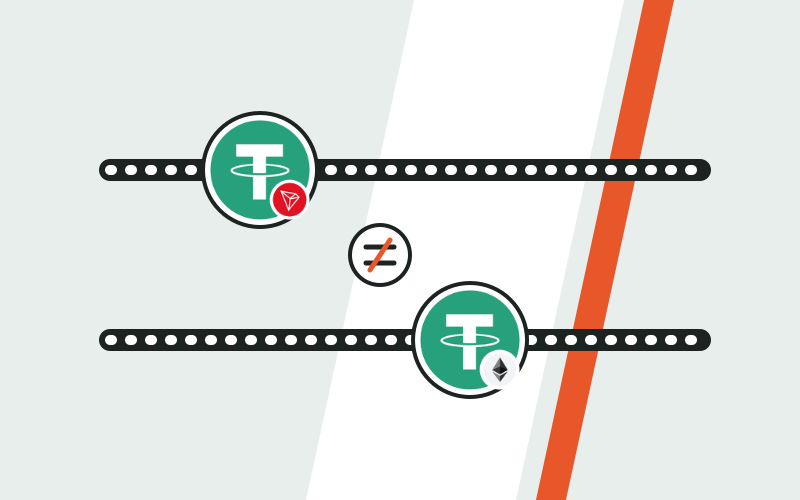
A USDT network fee is what the blockchain charges to record your transfer, paid in that chain's own coin. On 3 November 2026 it was about 6.5 TRX ($2.10) on Tron to an address that already holds USDT and 13 TRX ($4.21) to a new one, and about $0.006 on Ethereum (54,128 gas at 0.052 gwei with ETH at $2,290.69). Sending from an exchange, its own flat withdrawal fee applies instead: from 0.01 to 5.5 USDT that day, depending on the exchange and the chain.
Those figures come straight from each chain's pricing rules, worked out line by line below. For what USDT is and where it lives, start with the USDT guide.
You'll also see what three exchanges charge per network, when staking TRX pays for itself and why a fee can come out twice what you expected.
What does it cost to send USDT on each network?
From your own wallet on 3 November 2026: about $2.10 to $4.32 on Tron and about $0.006 on Ethereum. Exchanges charge their own price per chain instead.
Network cost of one USDT send from a personal wallet, 3 November 2026
| Network | Binance | KuCoin | Bitget | Zilligo accepts |
|---|---|---|---|---|
| Tron (TRC-20) | 4 USDT | 1.99 USDT | 1.5 USDT | Yes |
| Ethereum (ERC-20) | 0.6 USDT | 5.5 USDT | 2 USDT | Yes |
| BNB Chain (BEP-20) | 0.01 USDT | 1 USDT | 0.01 USDT | No |
| Solana | 0.7 USDT | 1.5 USDT | 0.5 USDT | No |
| TON | 0.3 USDT | 0.5 USDT | 0.15 USDT | No |
| Arbitrum One | 0.3 USDT | 1 USDT | 0.1 USDT | No |
| Polygon | Withdrawals paused | 0.8 USDT | 0.07 USDT | No |
USDT withdrawal fees from each exchange's public fee data, read on 3 November 2026. They change without notice.
Why does a Tron transfer cost $2 to $4?
Tron prices a USDT transfer in two resources, energy and bandwidth. If you have none, it burns TRX from your balance to cover them.
Pays for running the USDT contract. No free allowance: you stake TRX for it or burn 100 sun (0.0001 TRX) per unit.
Pays for the transaction's size, about 345 units. Each account gets 600 free a day; after that it's 1,000 sun per unit.
Whatever your staked resources don't cover is paid by burning TRX. That burn is your fee.
Example: A TRC-20 send to an address that holds USDT
Burn rates and the free allowance from Tron's chain parameters on TronGrid, 3 November 2026.
Example: A TRC-20 send to a brand-new address, second send of the day
A one-time deposit address, such as a Zilligo order's, has never held USDT, so expect this end of the range.
The rate itself has been 100 sun per unit of energy since a Tron governance vote cut it from 210 in August 2025. Before that, the same transfer burned about twice as much TRX.
What does an Ethereum transfer cost, and why does it swing?
Ethereum charges gas used x gas price, paid in ETH. A USDT transfer uses about 54,128 gas; the gas price rises and falls with demand, block by block.
| Gas price | When you might see it | ETH paid | In dollars at $2,290.69 |
|---|---|---|---|
| 0.052 gwei | Etherscan average, 3 Nov 2026 | 0.0000028 ETH | About $0.006 |
| 0.117 gwei | Etherscan reading, 6 Oct 2026 (ETH then $2,694) | 0.0000063 ETH | About $0.017 |
| 1 gwei | A busier hour | 0.000054 ETH | About $0.12 |
| 5 gwei | A rush | 0.00027 ETH | About $0.62 |
| 30 gwei | A rare spike | 0.0016 ETH | About $3.72 |
Each line is 54,128 gas multiplied by the gas price. The 1, 5 and 30 gwei lines are our own arithmetic to show the swing, not readings.
Dollar cost of one ERC-20 transfer at different gas prices, ETH $2,290.69
Gas sat far below 1 gwei through autumn 2026, which is why ERC-20 was the cheaper network from a personal wallet. That can change in an afternoon, so check the fee your wallet shows before you confirm.
What do exchanges charge to withdraw USDT?
A flat price per network, set by the exchange. It replaces the chain's own fee, and it can sit far above or below what the chain actually charges.
Chain cost, 3 Nov 2026
- Tron: about $2.10 to $4.32
- Ethereum: about $0.006
- Paid in TRX or ETH from your wallet
Exchange fee, same day
- Tron: 1.5 to 4 USDT
- Ethereum: 0.6 to 5.5 USDT
- Taken in USDT from your balance
Most exchanges subtract the fee from the amount you type. When the receiver needs an exact figure, add the fee first.
Example: Withdrawing for a $500 virtual Visa order from Binance
Assumes 1 USDT = $1, a card after your first (a first card adds a $10 issuing fee) and that the fee is deducted from the amount entered. Check how your exchange shows it.
| Charge | Who receives it | How it is set |
|---|---|---|
| Network fee | The blockchain | Energy and bandwidth on Tron, gas on Ethereum |
| Exchange withdrawal fee | The exchange | A flat amount per coin and network |
| Zilligo fee | Zilligo | 1% to 2% of the payout, on top, shown before you send (fees) |
You pay either the network fee or the exchange fee, never both, plus the payout fee if you are cashing out.
Does sending more USDT cost more?
No. The chain charges for the work, not the value. That makes the fee a large slice of a small send and a rounding error on a big one.
A $4.21 Tron fee as a share of the amount sent
Moving $500 as ten $50 sends on Tron, to an address that holds USDT
- USDT delivered$500.00
- Ten network fees of about $2.10about $21.00
- Total costabout $521
Is staking TRX worth it to cut Tron fees?
Only if you send on Tron most days. Staking locks TRX in exchange for a daily share of the network's energy, so your sends stop burning TRX.
Tron hands out 180 billion energy a day, split among all TRX staked for energy. On 3 November 2026 that was about 18.5 billion TRX, or about 9.7 energy per staked TRX per day.
Example: Staking to cover one Tron send a day
Sends to new addresses need about 13,350 TRX staked, roughly $4,320. The energy per TRX moves as others stake or unstake.
Staking might suit you if
- You send USDT on Tron several times a week.
- You can leave the TRX untouched for months.
- You can wait 14 days to unlock it.
- A fall in TRX's price wouldn't hurt more than the fees you save.
Some services rent out energy for less than the burn price. You are trusting a third party with that deal, and prices vary, so compare carefully. Zilligo offers neither staking nor energy.
Why did my fee come out higher than expected?
Usually one of five reasons, and the first explains most surprises.
On Tron, an address that has never held USDT needs about 130,000 energy, double the usual.
The 600 free units cover about one send a day on Tron; the next pays about 0.345 TRX.
Same TRX or ETH burned, more dollars.
Its flat withdrawal fee applied, not the chain's price.
A busy hour can multiply the gas price many times over.
One more: a failed transaction can still cost you. On Ethereum, gas used before the failure is paid; on Tron, energy a failed contract call consumed is still burned.
How do you pay the least on your next USDT send?
Four habits cover nearly every saving.
- Step 1Compare both networks on the day
On your own send screen. In November 2026 ERC-20 won from a personal wallet; on exchanges it varied.
- Step 2Keep a little TRX or ETH
From your own wallet the fee is paid in the chain's coin; with none, the send fails.
- Step 3Send once, not many times
The fee is flat, so batching saves it outright.
- Step 4Stake only if you send daily
Otherwise burning a few dollars of TRX is simpler and keeps your money free.
Choosing between the two networks for other reasons too? The TRC-20 vs ERC-20 comparison covers speed and address formats.
Now it is your turn
A USDT network fee is the chain's price for the work: energy and bandwidth on Tron, gas on Ethereum, the same for any amount.
In November 2026 that made Ethereum the cheaper road from a personal wallet, while exchanges set their own prices per chain.
Read the fee on your confirm screen, send in one go, and keep a few dollars of TRX or ETH ready.
Start a cashoutFrequently asked questions
Can I pay the USDT network fee in USDT?
Not from a personal wallet on Tron or Ethereum: the fee is paid in TRX or ETH. An exchange takes its withdrawal fee in USDT from your balance instead.
Does Zilligo charge a network fee?
No. The network fee goes to the blockchain when you send. Zilligo charges only its payout fee, 1% to 2% added on top and shown before you send. See the fees page.
Why was my Tron fee double the last one?
Most often the receiving address had never held USDT, which needs about 130,000 energy instead of 65,000. Running out of free bandwidth or a higher TRX price also raise it.
Is TRC-20 always cheaper than ERC-20?
No. On 3 November 2026 an ERC-20 send from a personal wallet cost about $0.006 against $2.10 to $4.32 on Tron. On exchanges, which network was cheaper depended on the exchange.
Which network is cheapest for USDT overall?
That day, BNB Chain withdrawals cost 0.01 USDT on Binance and Bitget. But a cheap chain only helps if the receiver credits it; Zilligo accepts TRC-20 and ERC-20 only.
Do I pay a fee if a USDT transfer fails?
Usually yes. On Ethereum the gas used before the failure is still charged, and on Tron the energy a failed contract call used is still burned. Leave enough TRX or ETH in the wallet.
Sources
- Paying for resourcesTRON Developer Hub
- Resource modelTRON Developer Hub
- Unstaking and cancellationTRON Developer Hub
- Chain parameters (wallet/getchainparameters)TronGrid
- Ethereum gas trackerEtherscan
- Gas and feesethereum.org
- Withdrawal feesBinance
- USDT currency details (public API)KuCoin
- Fee scheduleBitget
- TRON priceCoinGecko