
Quick answer
A bank cannot receive USDT itself, so the coins have to be sold first. There are three routes: sell on an exchange and withdraw to your bank, send the USDT to a payout service that pays out by bank transfer (on Zilligo: SEPA in about 1 to 2 hours, ACH in 1 to 2 business days, Wise in minutes, for a 1% fee), or sell to another person on a P2P market. In the EU, licensed platforms have stopped offering USDT under MiCA, and Revolut removed it on 31 August 2026.
New to the coin itself? The USDT guide explains what it is and which networks carry it. This page does one job: getting it into a bank.
You'll see the three routes that still work in late 2026, what each one costs and how long it takes, plus the European rules that closed several doors this year.
Can USDT go straight into a bank account?
No. A bank account holds money in a currency like dollars or euros, not tokens. Your USDT has to be sold, and the buyer sends the money to your bank over a normal payment rail.
Your bank then sees an ordinary incoming transfer. It doesn't see the blockchain, your wallet or the USDT.
What are the ways to get USDT into your bank?
Three routes cover almost everyone: an exchange, a payout service or a P2P trade. Here is what each asks of you.
| Route | What you need | What you pay | Money in the bank |
|---|---|---|---|
| Exchange | A verified exchange account and a linked bank | Deposit network fee, trading fee or spread, bank withdrawal fee | Depends on the exchange and the rail |
| Payout service | A free account and your bank details | Network fee, plus the service fee (1% for Zilligo bank payouts) | Zilligo: minutes (Wise) to 1 to 2 business days (ACH) |
| P2P trade | An account on a P2P market and a buyer | The price gap the buyer offers, sometimes a platform fee | As soon as the buyer pays, if they pay |
The cost and the wait for each route are covered in the chapters below.
Easiest when your USDT already sits on one and your bank is linked.
Send from any wallet; pick the bank rail and see the exact amount before you send.
Can be cheap, but you deal with a stranger who pays your bank directly.
How does the exchange route work?
You move the USDT onto an exchange, sell it for your currency and withdraw to your bank. It's four steps, and three of them can carry a fee.
- Step 1Deposit on a network the exchange supports
Open the exchange's USDT deposit page, choose the network and copy that address. You pay the network fee to send.
- Step 2Sell or convert
Trade USDT for dollars or euros. The exchange takes a trading fee, a spread in the price, or both.
- Step 3Withdraw to your linked bank
Choose ACH, SEPA or a wire, if the exchange offers it where you live. Some charge for this step.
- Step 4Wait for the bank rail
The exchange's withdrawal queue plus the rail's own timing.
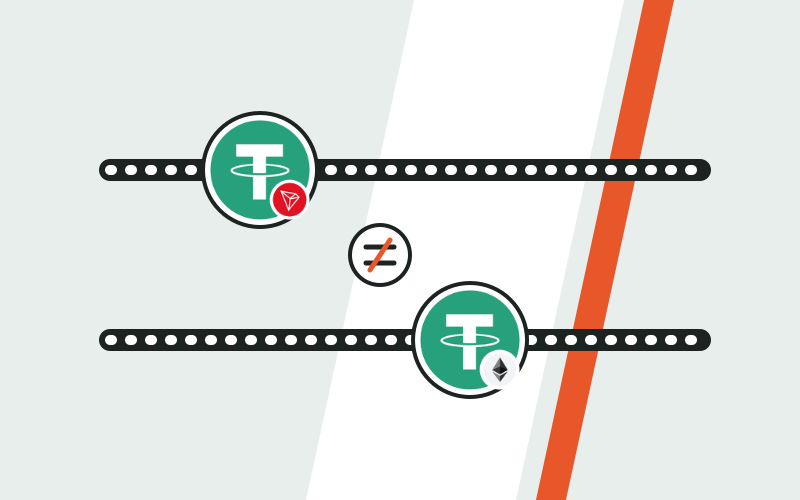
The deposit step is where the network choice matters. On 3 November 2026 an ERC-20 send from a personal wallet cost under one cent and a TRC-20 send about $2 to $4. The TRC-20 vs ERC-20 comparison has the arithmetic.
How does a payout service send USDT to your bank?
You create one order, send USDT to the address it shows and receive a bank transfer. On Zilligo every bank payout costs 1%, added on top of the amount you want to receive.
| Payout | Lands in | Details you enter | Max per order | After your USDT confirms |
|---|---|---|---|---|
| SEPA | Any EU or EEA euro account | IBAN and account holder name | $15,000 | About 1 to 2 hours |
| N26 | Your N26 euro account, by SEPA | IBAN and account holder name | $5,000 | About 1 to 2 hours |
| ACH | Any US bank account | Routing number and account number | $15,000 | 1 to 2 business days |
| Chime | Your Chime account | Chime routing and account number | $1,000 | 1 to 2 business days |
| Wise | Your Wise balance | The email on your Wise account | $15,000 | Minutes |
| Revolut | Your Revolut account | Revtag, email or phone | $5,000 | Minutes |
| Monzo | Your Monzo account | Email or phone on the account | $5,000 | Minutes |
Zilligo's bank and banking app payouts. Orders start at $50 on Chime, $100 on N26, Revolut and Monzo, $500 on SEPA and Wise and $1,000 on ACH, and the quote and amount are held for 20 minutes.
Largest single order by bank payout, in US dollars
Here is what an order looks like once it's created. The page shows the exact USDT, the network and a one-time address.
 2,020.00USDT on Ethereum (ERC-20)
- Send crypto
- Confirming
- Payout sent
Payout: $2,000.00 to your IBAN by SEPA
- Minute 0Order created
Status: Waiting for your payment. The quote holds for 20 minutes.
- Minute 2USDT sent
Status: Payment received, confirming.
- A few minutes laterCoins confirmed and the order checked
Status: Payout on its way. A person on our team checks every order, and some show On hold for review first.
- About 1 to 2 hours laterSEPA transfer lands
Status: Payout sent. By ACH, allow 1 to 2 business days.
What it costs
Where the USDT goes on a $1,000 bank payout sent as ERC-20 from a personal wallet
- Reaches your bank$1,000.00
- Zilligo fee, 1%$10.00
- Ethereum network fee, 3 Nov 2026under $0.01
- Leaves your walletabout $1,010.01
Outside Europe and the US, Zilligo has no direct local bank payout. Wise, which works in 40+ currencies, is the usual bridge; the countries page shows what works where you live.
Is a P2P trade a good way to reach your bank?
Sometimes. On a P2P market you sell USDT to another person, who pays your bank directly while the platform holds your coins in escrow.
Why people use it
- Works in countries with no other bank route
- Buyers compete on price
- Payment can arrive quickly
What can go wrong
- The money comes from a stranger's account
- If those funds were stolen, your bank can freeze or reverse them
- Fake payment screenshots
- Disputes take days to settle
Reasons to avoid it altogether: large amounts, an account you rely on for salary, or a buyer who asks to move the chat elsewhere. The scams guide covers the common tricks.
What changed for USDT and European banks?
Under the EU's MiCA rules, licensed platforms may only offer stablecoins from an authorised issuer, and Tether hasn't sought that for USDT. Through 2025 and 2026, the big names removed it for European customers.
- 2024Coinbase removes USDT
One of the first large platforms to drop it for EEA users.
- 31 Mar 2025Binance and Kraken follow
Binance removes USDT spot pairs for EEA users, leaving Convert. Kraken converts EEA balances to another stablecoin.
- 1 Jul 2026MiCA's grace period ends
Crypto platforms in the EU must hold a full licence.
- 6 Jul 2026Revolut stops USDT buys
For customers in the EEA and Switzerland.
- 31 Aug 2026Revolut delists USDT
Remaining balances are converted to each customer's base currency.
What it means for you: the rules target issuers and platforms, not coins in a wallet you control. You can still hold and send USDT; selling it on an EU-licensed exchange is what got harder.
Send USDT from your wallet to an order that pays euros to your IBAN.
USDC is authorised under MiCA, but the swap costs a fee and a step.
Tax and reporting duties still apply wherever you live.
How long does each route take?
After your USDT confirms, the bank rail sets the pace. SEPA usually lands within hours, ACH within business days, and Wise within minutes.
Time from confirmed USDT to money in the account, Zilligo bank payouts, in hours
Exchanges vary too much to chart honestly. Their withdrawal queue comes first, then the same SEPA or ACH timing applies.
What will your bank see, and what should you keep?
Your bank sees an incoming transfer and the sender's name, nothing about the coins. A first payment, or one much larger than usual, can trigger a routine question about where the money came from.
Answer it plainly: you sold USDT and were paid by bank transfer. The order reference and the transaction hash prove it.
Before your first USDT to bank payout
- The account is in your own name, and the name you enter matches the bank's records.
- Europe: the full IBAN, copied from your banking app.
- US: the ACH routing number, not the wire number, and the account number, not a card number.
- The network on your wallet matches the order: TRC-20 or ERC-20.
- You saved the order reference and the transaction hash.
Selling USDT can still be a taxable event where you live, even though its price stays near $1. This is general information, not tax advice; see crypto tax when you cash out.
Now it is your turn
Getting USDT into a bank always means selling it first. The real choice is who buys it: an exchange, a payout service or a stranger.
Pick the rail your bank uses, check the network before you send, and keep the order reference until the money has landed.
In Europe, remember that holding USDT is fine; it's the EU platforms that stopped selling it.
Start a cashoutFrequently asked questions
Can I send USDT straight to my IBAN?
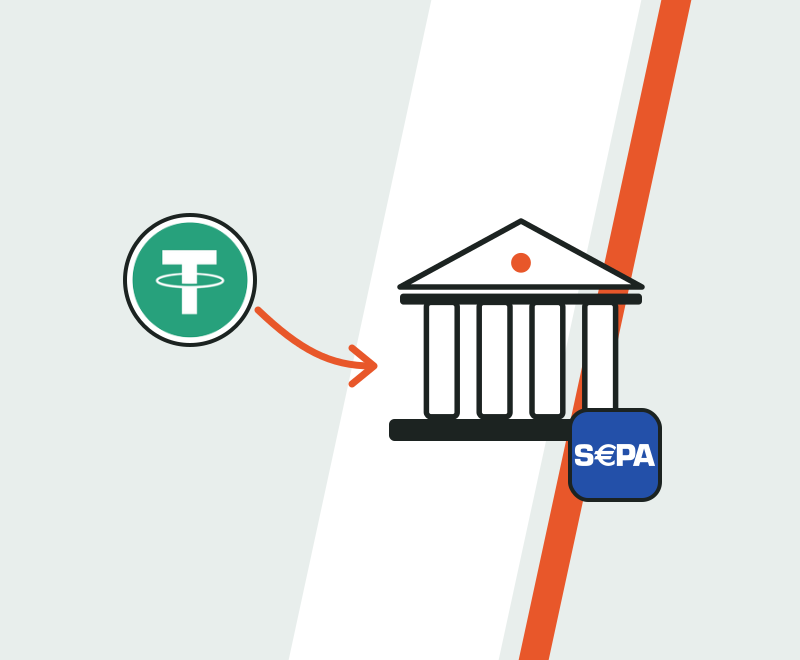
No. An IBAN receives euros. A SEPA payout order sells the USDT and sends the euros to your IBAN in one step, so you enter the IBAN and the account holder name and send the coins.
What is the cheapest way to move USDT to a bank?
Compare the amount that reaches your bank, not the headline fee. On Zilligo a bank payout costs 1% plus the network fee. On an exchange add the deposit network fee, the trading fee or spread and any bank withdrawal fee.
How long does USDT to bank take?
On Zilligo, after the USDT confirms: minutes for Wise, Revolut and Monzo, about 1 to 2 hours for SEPA and N26, and 1 to 2 business days for ACH and Chime.
Can I still cash out USDT to a European bank after MiCA?
Yes. MiCA limits what licensed EU platforms may offer, not what you hold in your own wallet. You can send USDT to a SEPA payout, or swap it to an authorised stablecoin such as USDC first.
Can the payout go to someone else's bank account?
Use an account in your own name. Payments to third parties are the ones banks question most, and a name that doesn't match can get the transfer held or sent back.
I live outside Europe and the US. What can I use?
Zilligo has no direct local bank payout there yet. Wise, PayPal, mobile top-up and Western Union or MoneyGram cash pickup are the usual alternatives; the countries page lists what works where.
Sources
- Revolut to delist USDT citing regulatory and risk concernsCointelegraph
- Binance to delist non-MiCA stablecoins for EEA users on March 31Cointelegraph
- Kraken to delist USDT and other stablecoins in Europe for MiCA complianceCointelegraph
- Single Euro Payments Area (SEPA)European Central Bank
- What is ACH?Nacha
- Ethereum gas trackerEtherscan
- Digital assetsIRS