
Quick answer
TRC-20 is USDT on the Tron blockchain and ERC-20 is USDT on Ethereum: the same Tether token worth $1, carried by two different chains. On 3 November 2026 a send from your own wallet cost about $2.10 to $4.21 on Tron and under one cent on Ethereum, while exchange withdrawal fees ran from 0.6 to 5.5 USDT depending on the exchange. Always use the network the receiver names; when you get to choose, compare the two fees on your own send screen.
Both networks carry the same Tether dollar, as the USDT guide explains. What changes between them is the fee, the wait, the shape of the address and who will accept the coins.
Below, each of those differences gets real numbers, including withdrawal fees from three exchanges read on the same day, so you can pick the cheaper road for your next transfer.
What is the difference between TRC-20 and ERC-20?
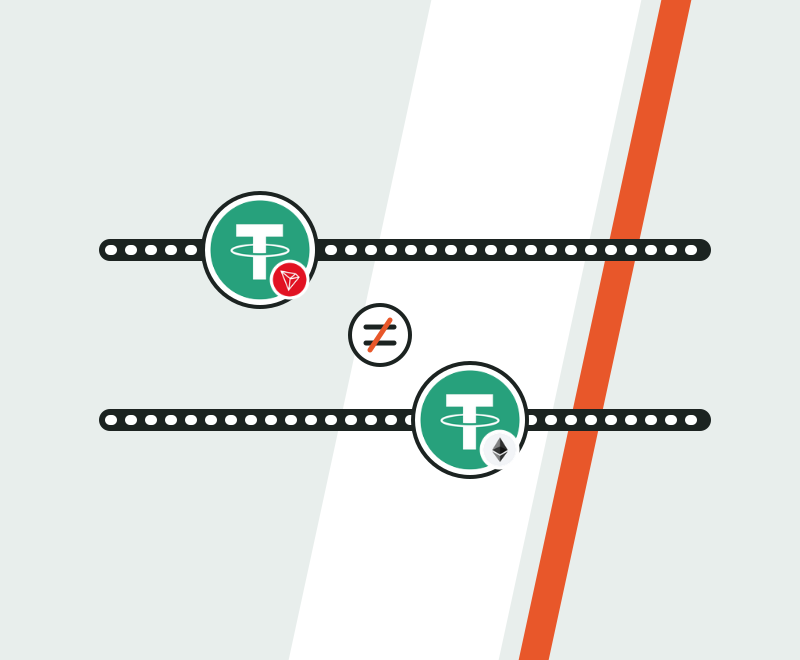
They are two token standards on two separate blockchains. TRC-20 is the rulebook tokens follow on Tron; ERC-20 is the rulebook on Ethereum. Tether issues USDT under both.
The dollar value is identical. The road is what differs, and the road decides the fee, the address you paste and how long the receiver waits.
| TRC-20 (Tron) | ERC-20 (Ethereum) | |
|---|---|---|
| Address | Starts with T, 34 characters | Starts with 0x, 42 characters |
| Fee paid in | TRX (energy and bandwidth) | ETH (gas) |
| Wallet fee, 3 Nov 2026 | About $2.10 to $4.21 | Under one cent |
| New block every | 3 seconds | 12 seconds |
| USDT on the chain, 3 Nov 2026 | $92.6 billion | $68.9 billion |
| USDT contract | TR7NHqjeKQxGTCi8q8ZY4pL8otSzgjLj6t | 0xdAC17F958D2ee523a2206206994597C13D831ec7 |
| Block producers | 27 elected Super Representatives | An open set of staking validators |
| Accepted by Zilligo | Yes | Yes |
Fees worked out below from TronGrid and Etherscan readings on 3 November 2026. Supply from DefiLlama the same day.
Which is cheaper to send from your own wallet?
Right now, Ethereum. On 3 November 2026 a USDT transfer on Ethereum cost well under one cent, while the same transfer on Tron burned about $2 to $4 of TRX.
Network cost of one USDT send from a personal wallet, 3 November 2026
The Tron arithmetic
A USDT transfer on Tron needs about 65,000 energy if the receiving address already holds USDT and about 130,000 if it has never held any. With no staked TRX, the network burns 100 sun (0.0001 TRX) for each unit.
Example: One TRC-20 send, no staked TRX, 3 November 2026
TRX at $0.3235 (CoinGecko). Burn rates read from Tron's chain parameters on TronGrid.
Here's the part most comparisons skip: a one-time deposit address has never held USDT, so a send to it usually costs the higher figure. A Zilligo order uses a new address each time.
The Ethereum arithmetic
A USDT transfer on Ethereum uses about 54,128 gas. Multiply by the gas price and the ETH price and you have the fee.
Example: One ERC-20 send, two readings
Gas readings from Etherscan's gas tracker. The 30 gwei line is our own arithmetic to show how far the fee can swing.
The full breakdown, including staking and other chains, is in USDT network fees.
Which is cheaper to withdraw from an exchange?
It depends on the exchange, not on the chain. Each one sets a flat fee per network, and on 3 November 2026 three large exchanges disagreed about which network should cost more.
| Exchange | TRC-20 fee | TRC-20 minimum | ERC-20 fee | ERC-20 minimum |
|---|---|---|---|---|
| Binance | 4 USDT | 10 USDT | 0.6 USDT | 5 USDT |
| KuCoin | 1.99 USDT | 4 USDT | 5.5 USDT | 30 USDT |
| Bitget | 1.5 USDT | 5 USDT | 2 USDT | 5 USDT |
USDT withdrawal fees from each exchange's public fee data, read on 3 November 2026. They change without notice, so check your own withdraw screen.
USDT withdrawal fee by exchange and network, 3 November 2026
Notice the gap between these figures and the chain's own price. Binance charged 4 USDT for a Tron send that burns about $2.10 to $4.21, and KuCoin charged 5.5 USDT for an Ethereum send that cost under a cent on chain.
Which one is faster?
Tron, by a small margin. It adds a block every 3 seconds against Ethereum's 12, but what the receiver waits for is the number of confirmations it demands.
| Who is receiving | TRC-20 confirmations | ERC-20 confirmations | Rough wait for ERC-20 |
|---|---|---|---|
| Binance deposit | 1 | 6 | About 1 minute 12 seconds |
| KuCoin deposit | 3 | 64 | About 13 minutes |
Confirmation counts from each exchange's public data, 3 November 2026. Wait times are blocks multiplied by block time, before any queue.
Minutes before an exchange credits a USDT deposit, by its confirmation rule
For a cashout, both are quick enough. A Zilligo quote is held for 20 minutes, and the usual delay is the time it takes you to copy the address and check it.
How do you tell a TRC-20 address from an ERC-20 address?
Read the first characters. A Tron address starts with a capital T and has 34 characters. An Ethereum address starts with 0x and has 42.
 Tron (TRC-20)
Tron network. The address starts with T and has 34 characters.
Send Ethereum (ERC-20)
Ethereum network. Several other chains also use 0x addresses.
SendA T address can only be Tron, so wallets usually refuse to send it on Ethereum. The 0x format is the trap: BNB Chain, Arbitrum and Polygon use it too, so a wallet will happily send to an Ethereum address on the wrong chain.
| Network label you may see | Means | Address starts |
|---|---|---|
| TRC20, TRX, Tron | USDT on Tron | T |
| ERC20, ETH, Ethereum | USDT on Ethereum | 0x |
| BEP20, BSC, BNB Smart Chain | USDT on BNB Chain, not Ethereum | 0x |
| Arbitrum One, Polygon | USDT on those chains, not Ethereum | 0x |
Exchanges name the same network in different ways. Match the full name, not the logo.
Before you press Send
- The network name matches what the receiver asked for, word for word.
- The first character fits: T for Tron, 0x for Ethereum.
- The first and last four characters match the address you were given.
- You hold a little TRX or ETH for the fee, or you are sending from an exchange.
Which network has more USDT, and who accepts each?
Tron carries more USDT, about $92.6 billion against Ethereum's $68.9 billion on 3 November 2026. Together they hold about 90% of all USDT on chain.
USDT on each chain, 3 November 2026, in billions of US dollars
The big ones take both, each with its own fee and confirmation rule.
Most multi-chain wallets hold both. Single-chain wallets show only their own chain's USDT.
Accepts USDT on TRC-20 and ERC-20. The payout fee is the same on either.
Tether can freeze USDT at an address on either chain, with a separate list for each.
On safety, the token behaves the same on both. Tron relies on 27 elected block producers, while Ethereum spreads the job over a large open set of validators. For someone sending a few hundred dollars, the bigger risk on either chain is a wrong address or network.
So which should you pick?
Use the network the receiver names. When both are on offer, pick by where the USDT sits now and what each fee costs you today.
Ethereum was far cheaper in November 2026, provided you hold a little ETH for gas.
Compare that exchange's two fees. On Binance ERC-20 won; on KuCoin and Bitget TRC-20 did.
Use it. Switching chains first costs another fee and adds a step that can go wrong.
Don't, unless the receiver lists it. Zilligo takes TRC-20 and ERC-20 only.
Cashing out with Zilligo? Create the order on the USDT page, pick TRC-20 or ERC-20 and the page shows the exact amount and a one-time address for that network. Payout fees are on the fees page.
Now it is your turn
TRC-20 and ERC-20 move the same dollar token. The choice is about cost on the day, the receiver's rules and which address you are holding.
In late 2026 Ethereum was the cheaper road from a personal wallet, and exchanges priced the two networks however they liked.
Open your send screen, compare the two numbers and match the network to the receiver. That habit beats any rule of thumb.
Start a cashoutFrequently asked questions
Is TRC-20 USDT worth the same as ERC-20 USDT?
Yes. Both are issued by Tether and target $1. To move from one chain to the other you need an exchange or a swap service, which charges its own fee.
Why do so many guides say TRC-20 is cheaper?
Because for years Ethereum gas was expensive. In late 2026 gas sat far below 1 gwei, so an ERC-20 send from a personal wallet cost under a cent, while Tron still burned 6.5 to 13 TRX without staking.
Can I send TRC-20 USDT to an ERC-20 address?
Most wallets block it, because a T address and a 0x address have different formats. If a send ever goes through on a mismatched chain, only whoever controls the receiving address can try to recover it.
Which network do exchanges prefer?
Most large exchanges accept both. Each sets its own withdrawal fee and confirmation rule per network, so the cheaper or faster one differs from exchange to exchange.
Do I need TRX or ETH to send USDT?
From a personal wallet, yes: Tron fees are paid in TRX and Ethereum fees in ETH. Withdrawing from an exchange, you pay the exchange's fee in USDT instead.
Does Zilligo charge more on one network?
No. The Zilligo fee depends on the payout, from 1% to 2%, and is the same on TRC-20 and ERC-20. Only the network fee you pay your wallet or exchange differs.
Sources
- Supported protocolsTether
- Tether USDT supply by chainDefiLlama
- Paying for resourcesTRON Developer Hub
- Resource modelTRON Developer Hub
- Ethereum gas trackerEtherscan
- Gas and feesethereum.org
- Withdrawal feesBinance
- USDT currency details (public API)KuCoin
- Fee scheduleBitget