
Quick answer
A Bitcoin ATM suits small, same-hour cash sales but costs 10% to 25% all-in once its fee and rate markup are counted, and many US states now cap what it can take. An OTC desk suits one large trade, usually from about $50,000, priced inside a single quote after full ID checks. For amounts in between, a cashout service paying a bank at 1% costs far less than an ATM; a cash pickup costs 1.5% plus the provider's transfer cost, shown in the quote.
This comparison belongs to our Bitcoin cashout guide. It lines the two up on cost, limits, ID checks and risk, using 2026 figures from operators, US state laws and the FBI.
Then it shows where a cashout service fits between them, because for most amounts it is cheaper than the machine and far smaller than the desk.
What is the difference between a Bitcoin ATM and an OTC desk?
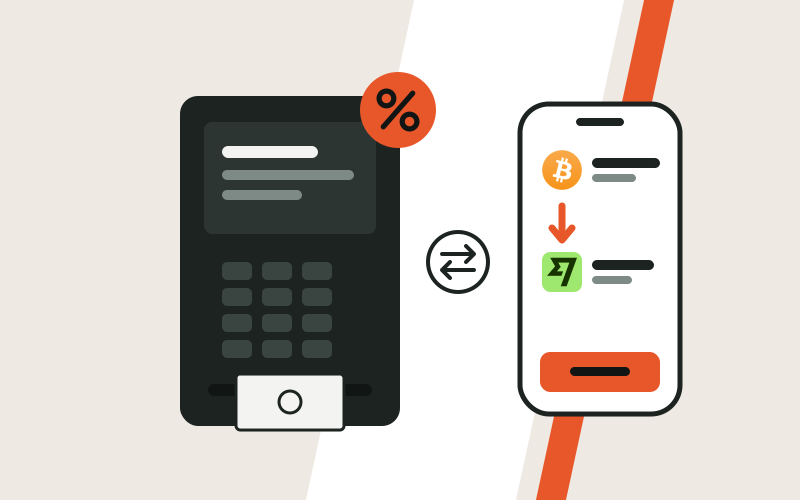
An ATM is a self-service kiosk for small amounts of cash. An OTC desk is a trading team for one large block of BTC, paid by bank wire.
Bitcoin ATM
- Paper cash at the machine
- Tens to a few thousand dollars
- 10% to 25% all-in
- Phone number or ID scan, set by the operator
- Many state daily limits apply
OTC desk
- Bank wire, often within a day
- Usually $50,000 and up
- Built into one quote
- Full identity and source-of-funds checks
- A named trader, by phone or chat
How does selling Bitcoin at an ATM work?
You pick Sell on the screen, verify yourself, send BTC to the address the machine shows, and collect banknotes once the payment confirms.
- At the machineChoose Sell and the cash amount
The screen shows its price per BTC and its fee.
- NextProve who you are
A phone code for small sales; an ID scan or selfie as the amount grows.
- ThenSend the BTC
Scan the QR code from your own wallet and send the exact amount.
- 10 to 30 minutesWait for a confirmation
Some machines pay on one confirmation; others print a code to redeem later.
- FinallyTake the cash
Count it before you leave the machine.
The wait at the machine is a Bitcoin confirmation like any other. Bitcoin confirmation times explains how your wallet's fee setting changes it.
How much does a Bitcoin ATM charge when you sell?
Coincub's 2026 review puts Bitcoin ATMs at 10% to 25% all-in. That covers two charges: the fee on the screen and a price per BTC set below the market.
What selling at a Bitcoin ATM costs
Selling usually carries a lower screen fee than buying, about 6% against about 12% at most operators. The markup still applies, so the fee you see is never the full price.
Where $1,000 of Bitcoin goes at a cheap ATM
- Cash in your hand$899.10
- Sell fee, about 6%$59.94
- Rate markup (estimate, 4%)$39.96
- Network fee$1.00
- BTC you send$1,000
How does an OTC desk work, and what is the minimum?
You open an account with full checks, ask for a quote on your whole amount, accept it within a short window, send the BTC and receive a bank wire. Kraken's desk handles trades over $50,000 and settles within 24 hours.
Why not just sell a large amount on an exchange? A big market order eats through the order book, so each slice fills at a worse price. A desk fixes one price for the full block and takes that risk itself.
| Desk | Published minimum | Settlement | Pricing |
|---|---|---|---|
| Kraken OTC | Trades over $50,000, in some countries | Within 24 hours, to your Kraken account, bank or wallet | Inside the quote; no fee table |
| Coinbase Prime | Not published | Agreed per client | Inside the quote |
| Other desks | Usually set by relationship | Bank wire, often same or next day | Inside the quote; compare more than one |
Kraken's figures are from its OTC page, checked 2026-11-03. Desks rarely publish fees, so the only fair comparison is two quotes at the same moment.
A desk fits when you want one clean trade, a named contact and paperwork your accountant can read. Below its minimum, it is simply not an option.
Which limits and ID rules apply to Bitcoin ATMs in 2026?
More every month. AARP counts 35 US states with crypto kiosk laws since 2023, 18 of them passed in 2026, and several now cap what a person can push through a machine in a day.
| Where | Rule | Reported |
|---|---|---|
| California | $1,000 per person per day; charges capped at the greater of $5 or 15% per transaction | Daily limit since 2024, fee cap since 2025 (DFPI) |
| Virginia | $2,000 a day for new customers, $5,000 for existing ones; fraud warnings on screen | AARP, September 2026 |
| South Dakota | $1,000 a day and $10,000 a month; full refunds for fraud victims | ABA Banking Journal, April 2026 |
| Indiana | Kiosks banned statewide | Signed 9 March 2026 |
| Spokane (WA), St. Paul (MN) | Kiosks banned by the city | 2025 |
| Australia | A$5,000 cap on cash deposits and withdrawals at crypto ATMs, plus scam warnings | Since June 2025 |
From the California DFPI, AARP (updated 14 September 2026), the ABA Banking Journal (2 April 2026) and AUSTRAC's June 2025 conditions. Laws change fast; check your state before you go.
Under the US Bank Secrecy Act, kiosk operators are money transmitters. They must report cash transactions over $10,000 in a day and can report suspicious activity at any amount. Each operator also sets its own ID tiers on top.
OTC desks sit at the opposite end: full identity checks every time, and questions about where the BTC came from. A standard Zilligo order collects no ID documents, though large or unusual orders may be reviewed by a person and orders linked to fraud or stolen funds are refused.
How big is the Bitcoin ATM scam problem?
Large and growing. The FBI received 13,460 complaints involving crypto kiosks in 2025, with about $389 million reported lost, up 58% on 2024.
Losses reported to the FBI involving crypto kiosks
The script rarely changes. The FTC found that 86% of loss reports at these machines were government, business or tech support impersonation, and the median loss in early 2024 was $10,000.
Hang up if you hear any of these
- Pay a fine, a tax or a bill at a Bitcoin ATM.
- Move your savings to a safe account through a machine.
- Stay on the line while you use the kiosk.
- Scan this QR code we are sending you.
- Do not tell your bank or your family.
Where does a cashout service fit between an ATM and an OTC desk?
In the large gap between them. A cashout service takes $50 up to $15,000 per order, which is above most kiosk limits and below most desk minimums, at 1% to a bank and 1.5% plus the provider's transfer cost to a cash pickup.
Cash in hand from $1,000 of Bitcoin
Need banknotes? A Western Union or MoneyGram payout is usually ready the same day for 1.5% plus their transfer cost, 1% per $1,000 or part of it and never more than $64, shown in your quote, for $100 to $5,000. The person collecting shows ID at the agent counter.

Western Unionnow
Ready for pickup$500.00 is waiting at your chosen agent. Bring photo ID and the tracking number.Going to a bank anyway? Pulling cash from a kiosk only to deposit it throws away 10% or more. A SEPA or ACH payout takes up to $15,000 per order at 1%; Bitcoin to a bank account compares those routes.
| Bitcoin ATM | Cashout service (Zilligo) | OTC desk | |
|---|---|---|---|
| Cost | 10% to 25% all-in | 1% to 2% plus the network fee; cash pickup adds a transfer cost | Inside one quote |
| Typical size | Tens to a few thousand dollars, often capped by state law | $50 to $15,000 per order, by payout | About $50,000 and up |
| ID | Set by the operator, rising with the amount | No ID documents for a standard order | Full checks |
| You receive | Banknotes | Bank, PayPal and other apps, cards, gift cards or a cash pickup | Bank wire |
| Speed | Once the BTC confirms | Minutes to 2 business days after confirming | Onboarding first, then within about a day |
Zilligo figures from its fee and limit pages; ATM costs from Coincub; OTC figures from Kraken's desk page.
Which should you use for your amount?
Decide by size first, then by what you need in your hand: an ATM only for small, urgent cash; a cashout service for nearly everything; an OTC desk for one big block.
A two-way ATM is about the only option. Expect to lose 10% or more.
A Western Union or MoneyGram pickup at 1.5% plus their transfer cost, usually the same day.
SEPA, ACH or Wise at 1%. No kiosk, no deposit slip.
Ask an OTC desk for a quote and compare it with a high-limit bank payout. See large amounts.
Is the exchange route an option too? Yes, once you have a verified account. Selling Bitcoin on an exchange has the 2026 fees.
Now it is your turn
An ATM charges a lot for speed and a desk serves only the biggest trades, so most sellers fall in the gap between them.
That gap is where a bank payout costs a fraction of the kiosk price and a same-day cash pickup shows its full cost before you send, without the desk's minimum.
If anyone ever tells you to go to a Bitcoin ATM, hang up first and think second.
Start a cashoutFrequently asked questions
Is a Bitcoin ATM or an OTC desk cheaper?
For the amounts each one accepts, the OTC desk. Its cost sits inside one quote and is usually small at large sizes, while an ATM costs 10% to 25% all-in. The two rarely overlap, because desks usually start around $50,000.
Can I sell Bitcoin at any Bitcoin ATM?
No. Many kiosks only sell BTC. Look for a two-way machine on the operator's map or app, and check its daily limit before you go.
What is the minimum for a Bitcoin OTC desk?
Kraken's desk serves trades over $50,000. Many desks, including Coinbase Prime, do not publish a minimum and set it per client.
How much can I sell at a Bitcoin ATM per day?
It depends on the operator and the state. California caps kiosks at $1,000 per person per day, Virginia at $2,000 for new customers and South Dakota at $1,000 a day, while Indiana has banned the machines.
Why does the ATM's Bitcoin price differ from the market price?
The operator buys your BTC below the market and keeps the gap, on top of the fee on the screen. Compare its price per BTC with a public chart to see the markup.
Can I get my money back after a Bitcoin ATM scam?
Rarely, because Bitcoin payments cannot be reversed. Contact the kiosk operator and your bank straight away, keep the receipt, and report it at ic3.gov and ReportFraud.ftc.gov. Some states now require operators to refund fraud victims.
How do I get cash for Bitcoin without an ATM?
Choose a Western Union or MoneyGram payout. It costs 1.5% plus their transfer cost, shown in your quote, is usually ready the same day and is collected at an agent counter with photo ID.
Sources
- The truth about Bitcoin ATM feesCoincub
- IC3 cryptocurrency kiosk complaint data by stateFBI Internet Crime Complaint Center
- Bitcoin ATMs: A payment portal for scammersFederal Trade Commission
- How states are taking aim at combating crypto ATM fraudAARP
- States tighten reins on crypto ATMsABA Banking Journal
- Court upholds daily transaction limit for crypto kiosksCalifornia DFPI
- Australia imposes AU$5,000 limit on crypto ATM transactionsFinance Magnates
- OTC trading deskKraken
- The Bank Secrecy ActFinCEN
- Application of FinCEN's regulations to certain business models involving convertible virtual currenciesFinCEN