
Quick answer
One Bitcoin confirmation takes about 10 minutes on average, because the network aims for one new block every 10 minutes. Pay at least the going fee rate and the first confirmation usually comes within 10 to 30 minutes. Exchanges then credit Bitcoin after 1 to 3 confirmations, so about 20 to 45 minutes. A fee set below the going rate can leave a payment waiting for hours.
That wait is the slowest step when you cash out Bitcoin, and it runs on two things: random block timing and the fee rate you picked.
Below you'll find real block and fee numbers from 2026, the confirmation counts Coinbase, Kraken and Binance publish, and the two tools (RBF and CPFP) that pull a stuck payment into a block.
The last chapter shows what your order page says at each stage, and why a slow block does not cost you the rate.
What counts as a Bitcoin confirmation?
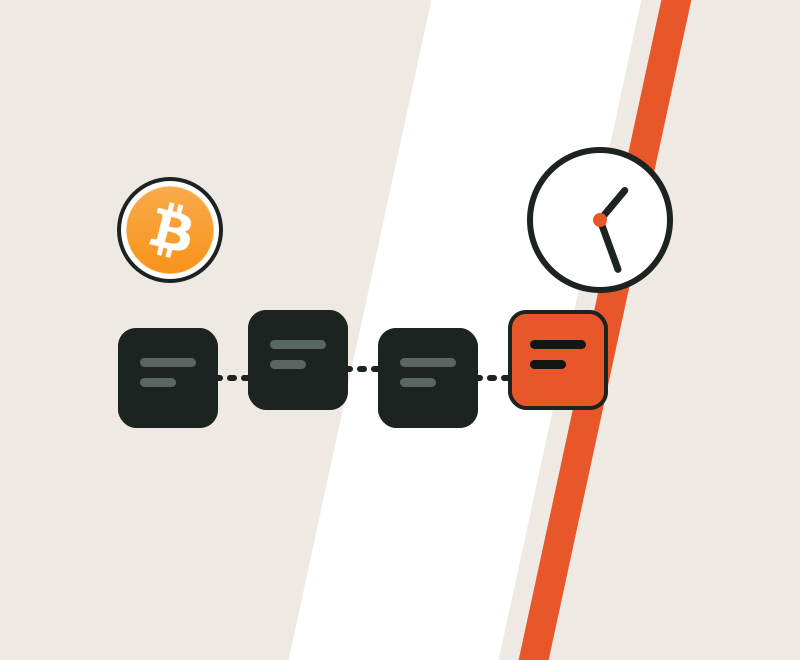
Your payment has one confirmation the moment a miner records it in a block. Each block stacked on top after that adds one more.
Until that first block, the payment has only been broadcast. Every node knows about it, yet none has written it down.
The mempool (memory pool) is that queue. Miners choose from it, and they reach first for the payments that pay the most per unit of block space.
Why wait for more than one block? A payment with zero confirmations can still be replaced by a different version. One block makes that very hard, and every extra block makes it harder still.
How long does one Bitcoin confirmation take?
About 10 minutes on average. Bitcoin resets its mining difficulty every 2,016 blocks so that blocks keep arriving at roughly that pace.
Average is the key word. Each block is found by luck, so the gap after one block has nothing to do with the gap before it. Two blocks can land a minute apart; the next can take 40 minutes.
Chance the next block arrives within...
The pace also drifts between resets. When miners switch machines off, blocks slow down until the next reset catches up: in June 2026, with hashrate down from over 1,000 to about 893 EH/s, the average gap ran above 11 minutes for about two weeks before a 10.09% difficulty cut.
Add your place in the queue on top of that, and 10 to 30 minutes to the first confirmation is a fair expectation when your fee matches the going rate.
How many confirmations do exchanges and services wait for?
Most big exchanges credit Bitcoin after 1 to 3 confirmations, so about 20 to 45 minutes. Each sets its own number and can change it, so the deposit screen is the final word.
| Who | Confirmations for Bitcoin | What that means in time |
|---|---|---|
| Binance | 1 to credit it, 2 before it is unlocked | About 20 minutes on average |
| Coinbase | 2 before it counts as final | About 20 minutes on average |
| Kraken | 3 before it is credited | About 45 minutes, by Kraken's own estimate |
| Bitcoin.org guidance | 6 for high-value transfers | About 1 hour on average |
From each company's help pages, checked 3 November 2026 (Kraken's updated 22 October 2026, Binance's 19 December 2025). These numbers change; check the deposit screen before you send.
Blocks each one waits for before your Bitcoin counts
Where does the famous "6 confirmations" come from? Bitcoin.org lists 6 as the minimum for high-value transfers, and 30 for emergencies when people may need time to step in.
Exchanges ask for fewer than six because each one weighs speed against safety and sets its own number. Fewer blocks simply means your deposit is credited sooner.
Selling on an exchange after the deposit lands? Selling Bitcoin on an exchange walks through the rest of that route.
What decides how fast your Bitcoin payment confirms?
Your fee rate, measured in sat/vB, compared with what everyone else in the queue is paying. Block space is limited, and miners sell it to the highest bidder.
So the fee follows how big the payment is in bytes, not how much money it moves. A simple payment from a bc1q address is about 141 vB whether it carries $50 or $50,000.
Network fee for one simple payment, by fee rate
How much does the going rate swing? From a record to almost nothing in two and a half years:
- 20 April 2024A record day
The halving and the Runes token launch filled blocks. The average fee per payment hit $128.45.
- 21 April 2024The rush fades
The average fell to about $34.80 a day later.
- August 2025A lower floor
Bitcoin Core's default minimum relay fee was cut from 1 to 0.1 sat/vB.
- 6 October 2026A quiet queue
About 77,700 payments waited, and 1 to 2 sat/vB reached the next block or two.
- 3 November 2026Today
1 sat/vB for the next block, the next half hour and the next hour alike.
Your address type changes the size, and so the fee. A bc1q payment is about 141 vB, a bc1p (Taproot) one about 154 vB and an old address starting with 1 about 226 vB. The Bitcoin pillar has the full size chart.
Spending many small deposits at once also makes a payment bigger, since each input adds about 68 vB from a bc1q address.
Why is my Bitcoin transaction stuck?
Almost always because its fee rate is lower than what the next blocks are taking. The payment is valid and waiting; it simply keeps losing its seat to better-paying ones.
The wallet's cheapest setting, or a fee typed by hand.
News or a token launch pushed the rate past yours.
Nodes now relay it, but many miners still pass it over.
An exchange withdrawal still in its own queue has no transaction ID.
Choose the fee setting and you choose the wait. On a calm day the gap is tiny, but the cheapest option is the first one left behind when the queue grows:
Typical wait for confirmation 1, by fee setting
Most wallets warn you before it happens. If you see a message like this, raise the fee before you press Send:
 Bitcoin
0.5 sat/vB is below the rate miners are taking now. This payment may wait many hours.
SendAnd if it never confirms? With default settings, Bitcoin Core nodes drop a payment after about two weeks in the mempool, and your wallet then shows the coins as yours again. Until it does, treat the payment as live, because anyone holding a copy can rebroadcast it.
How do you speed up a stuck Bitcoin transaction?
Two ways. Replace-by-fee (RBF) swaps the stuck payment for a copy that pays more. Child-pays-for-parent (CPFP) leaves it alone and adds a second payment generous enough to carry both.
Replace-by-fee (RBF)
RBF signs a new version that spends the same coins with a higher fee. Only one version can ever confirm, and miners take the better-paying one.
- Step 1Open the pending payment
In your wallet's history, tap the payment still marked unconfirmed.
- Step 2Choose Bump fee or Speed up
The wording varies. Avoid Cancel, which sends the coins back to you instead.
- Step 3Pick the next-block rate
Check a live mempool page first; the new rate must beat the old one.
- Step 4Save the new transaction ID
The replacement has a new ID. The old one will never confirm.
Since Bitcoin Core 28.0 (October 2024), nodes relay a replacement by default even if the first version did not flag itself as replaceable. Your wallet still has to offer the button, though, and a few do not.
Example: RBF after the queue jumps from 1 to 8 sat/vB
Hypothetical, at $80,000 per BTC, so 1 sat = $0.0008. Only one version confirms, so you pay one fee, not both.
Child-pays-for-parent (CPFP)
Most payments send leftover BTC back to you as change. CPFP spends that change in a new payment with a high fee. A miner can only collect that fee by also including the stuck parent, so the two usually confirm in the same block.
Example: CPFP for the same stuck payment
Hypothetical, at $80,000 per BTC, with sizes rounded from the Bitcoin Optech calculator. CPFP costs more than RBF because you buy space for two payments.
Replace-by-fee (RBF)
- Replaces the stuck payment
- Usually one button in the wallet
- Cheaper: one payment's space
- Gives a new transaction ID
Child-pays-for-parent (CPFP)
- Keeps the original payment
- Needs change, plus coin control
- Dearer: pays for two payments
- Keeps the original transaction ID
No button for either? Then waiting is the fallback. When demand drops, miners reach further down the queue, and most underpaid payments get in.
How do you check a Bitcoin payment on a block explorer?
Copy the transaction ID from your wallet and paste it into a block explorer. You'll see whether it confirmed, how many blocks deep it is and the fee rate it paid.
- Step 1Copy the txid
Open the payment in your wallet history, or in the exchange's withdrawal history.
- Step 2Open an explorer
Any public Bitcoin explorer works; mempool.space is a common choice.
- Step 3Paste the whole ID
No login is needed. A missing character returns nothing.
- Step 4Read three things
Confirmed or not, how many confirmations, and its fee rate next to today's next-block rate.
| The explorer says | What it means | Your next step |
|---|---|---|
| Unconfirmed | Waiting in the mempool | Compare its sat/vB with the next-block rate; bump it if far below |
| 1 confirmation | In a block | Give the service a block or two to reach its number |
| Several confirmations | Settled | Still not credited? Contact the service with the txid |
| Transaction not found | Not broadcast, dropped, or a mistyped ID | Copy the ID again, then ask your wallet or exchange |
What an explorer result means, in plain words.
What happens to a Zilligo order while your Bitcoin confirms?
Your order keeps its rate while it waits for the block. The 20 minute quote has to cover the moment your payment reaches the network, not the moment it confirms.
0.00501235BTC on Bitcoin- Send crypto
- Confirming
- Payout sent
Payout: $400.00 to your PayPal email
From the block to the money, payout times are the same as any other order: minutes for PayPal, cards and gift cards, about 1 to 2 hours for SEPA, and 1 to 2 business days for ACH.
| What happened | What your order does | What you do |
|---|---|---|
| Sent in time, confirming slowly | Stays on "Payment received, confirming" at the quoted rate | Nothing, or bump the fee if it is far below the queue |
| You bumped it with RBF | The new transaction ID is one the order has not seen | Send support the new txid with your order reference |
| You bumped it with CPFP | The original ID confirms, so the order follows it | Nothing extra |
| It reached the network after 20 minutes | Shows "Expired" or "On hold for review" | Write to support with your order reference; a payment within 24 hours can still be matched, at the rate when it is matched |
| A different amount arrived | Shows "On hold for review" | Wait for the team, or contact support with the txid |
Zilligo takes Bitcoin on the Bitcoin network only, so no Lightning payments. Every status is explained on how it works.
Message support on Telegram through the contact page. Include every transaction ID, the replacement from a fee bump too. Zilligo never asks for your seed phrase, private key, wallet password or remote access.
Wondering whether the price could slip while you wait? When to cash out Bitcoin shows how big Bitcoin's swings have been and what the locked quote covers.
Before you send Bitcoin to an order
- You checked the next-block rate on a live mempool page.
- Your wallet lets you pick the fee, not only a default.
- Your wallet can bump a fee (RBF) if the queue jumps.
- You send from a wallet you control, so you can bump it.
- The address starts with bc1, 3 or 1 and matches the order page.
- You know where your wallet shows the txid.
Now it is your turn
A Bitcoin confirmation is a block, and blocks keep their own random schedule: about 10 minutes on average, sometimes much longer.
You control the part that matters most, the fee rate, and RBF or CPFP can fix it after the fact.
Next time a payment says pending, open the explorer, compare two numbers, and you'll know within a minute whether to wait or bump.
Start a cashoutFrequently asked questions
Why does my wallet say sent while the other side shows nothing?
Sent usually means broadcast, not confirmed. Many services list an incoming payment only once it is in a block, and some only after their own number of confirmations. A block explorer shows which stage it has reached.
How long do 6 Bitcoin confirmations take?
About an hour on average, since each block averages 10 minutes. Because block timing is random, it can be 40 minutes on a fast run or well over an hour on a slow one.
Does sending more Bitcoin cost a bigger fee?
No. The fee is the payment's size in virtual bytes times the fee rate. Moving $50 or $50,000 costs the same if the payment takes the same space.
Is a payment with zero confirmations safe to accept?
Only from someone you trust. Until it is in a block, a different version can replace it. That is why exchanges and payout services wait for at least one confirmation.
Can I use Lightning to skip the wait?
Lightning payments settle in seconds, but only where both sides support it. Zilligo accepts on-chain Bitcoin on the Bitcoin network only, so a Lightning payment cannot reach an order.
What happens if my Bitcoin transaction never confirms?
Bitcoin Core nodes drop an unconfirmed payment after about two weeks by default, and your wallet then shows the coins back. Until then, assume it can still confirm, because anyone with a copy can rebroadcast it.
Is it safe to share my transaction ID?
Yes. The txid is already public on the blockchain. Never share your seed phrase or private keys, with support or anyone else.
Sources
- Some things you need to knowBitcoin.org
- Block chain (developer guide)Bitcoin Developer Documentation
- Replace-by-fee (RBF)Bitcoin Optech
- Child pays for parent (CPFP)Bitcoin Optech
- Default minimum transaction relay feeratesBitcoin Optech
- Transaction size calculatorBitcoin Optech
- Bitcoin Core 28.0 release notesBitcoin Core
- Cryptocurrency deposit processing timesKraken
- ConfirmationsCoinbase
- Why hasn't my deposit been credited?Binance
- Bitcoin's average transaction fee comes down after reaching record high amid Runes rolloutThe Block
- Bitcoin transaction fees explainedOneMiners
- Current Bitcoin transaction feessatsbeat (mempool.space data)
- Bitcoin difficulty drops 10% to lowest level since July 2025 as hashrate coolsBitcoin.com News