
Quick answer
The cheapest way to cash out crypto is a limit order on a low-fee exchange followed by a free bank withdrawal, if you already have a verified account: on Kraken Pro that costs 0.40% at the first fee tier, and US ACH withdrawals are free. Without an exchange account, a cashout service that adds one visible fee and no spread is next, from 1% to 2% at Zilligo. Bitcoin ATMs are the most expensive route, often 10% to 20% or more.
A cashout can carry five separate costs, and the advertised one is often the smallest. New to the topic? Start with how to cash out crypto.
This guide prices every route on the same $1,000: exchange order books, simple sell buttons, wallet off-ramps, P2P desks, crypto cards, cashout services and Bitcoin ATMs.
You'll see where each cost hides, how to measure a spread yourself, and which route wins at $100, $1,000 and $10,000.
What does a crypto cashout really cost?
The real cost is the gap between what your crypto is worth at the market price and what actually lands where you spend it.
Five costs can sit between those two numbers. Most routes show you one or two of them.
The line labelled "fee". Usually a percentage of the amount.
A worse rate than the market. Never shown as a fee.
Paid to the blockchain to move your coins. Flat per transfer.
What an exchange charges to send money to your bank.
Currency conversion, or a second move from an app to a bank.
Which way to cash out crypto is cheapest on $1,000?
If you already have a verified exchange account, a limit order on its order book is the cheapest route, followed by a free bank withdrawal.
Without one, the next cheapest is a route that shows a single fee and adds no spread. Here is how the published prices line up:
Published cost of each route, as a share of the amount
Percentages are easier to judge as dollars. This is what the same $1,000 of Bitcoin costs on each route:
| Route | Cost on $1,000 | What you need first |
|---|---|---|
| Kraken Pro, limit order (0.40%) | $4.00, free ACH withdrawal | A verified account; ACH takes 0 to 2 business days |
| Kraken Pro, market order (0.80%) | $8.00, free ACH withdrawal | A verified account |
| Zilligo SEPA or ACH (1% on top) | $9.90 | A free account; SEPA about 1 to 2 hours, ACH 1 to 2 business days |
| Kraken simple sell (1%) | $10.00 plus a spread | A verified account |
| MoonPay to a bank (from 1%) | From $10.00 plus a spread | An ID check the first time |
| Zilligo virtual Visa (2% on top) | $19.61, or $29.41 with the $10 issuing fee on a first card | A free account; lands in minutes after confirmation |
| P2P desk on an exchange | 0% to 0.35% platform fee, plus the buyer's price | A verified account and a buyer |
| Bitcoin ATM at 15% | About $150 | A machine nearby |
Published fees checked 3 November 2026. Sending the Bitcoin adds a network fee of about $1.50 on every route except the exchange whose balance already holds it. Kraken charges 1 EUR for a SEPA withdrawal.
Zilligo's fee depends on the payout, from 1% on bank payouts to 2% on the virtual Visa, which adds a $10 issuing fee on a first card. Western Union and MoneyGram add their own transfer cost. Every payout and its fee is on the fees page.
How much does the coin you send add to the cost?
Between a fraction of a cent and a few dollars per transfer. Solana and XRP are the cheapest coins to move.
Typical cost to send one transfer, in US dollars
Because the network fee is flat, it weighs heaviest on small cashouts. Take USDT on Tron at about $3:
A $3 network fee as a share of the order
Example: One $200 order against two $100 orders, both to Revolut in USDT on Tron
Two $100 orders pay the same $2.00 in fees but about $6.00 in network fees, about $8.00 in total. A worked example using a typical Tron fee.
Cashing out from an exchange? Its withdrawal fee replaces the network fee, and it can be higher. Check the fee next to each network on its withdrawal screen.
Why do Bitcoin ATMs cost so much more?
Because the operator's fee and a rate markup are stacked on top of each other, usually 10% to 20% or more once both are counted.
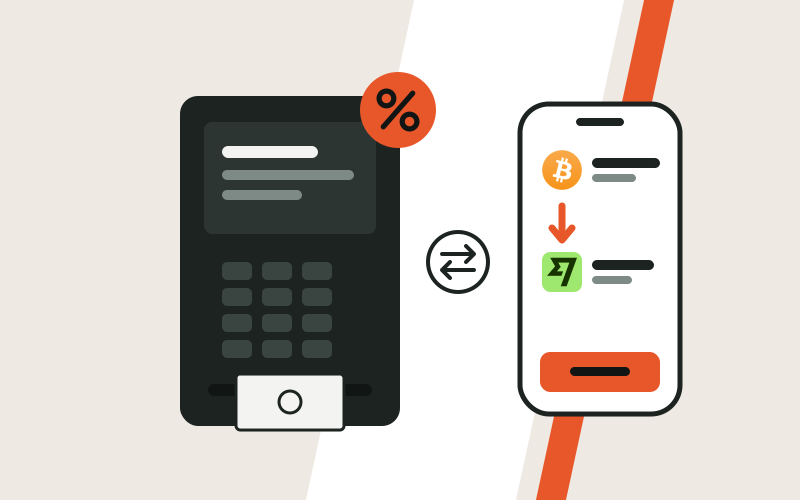
$300 of Bitcoin at an ATM charging 15%
- Cash you take home$255
- Fee and markup$45
- Bitcoin you put in$300
Cost of cashing out $300 of Bitcoin, three ways
Some places now cap ATM charges. In California, kiosk charges may not exceed the greater of $5 or 15% since 1 January 2025, and one customer can move at most $1,000 a day.
In the UK, the FCA says no crypto ATM operator is registered with it, which makes every machine operating there illegal.
An ATM still makes sense when you need paper money within the hour. The full trade-off is in Bitcoin ATM vs payment service vs OTC desk.
Are P2P trades and crypto cards really cheaper?
Their fees are low, but neither is free. On P2P the cost moves into the price a buyer offers. On a card it moves into the rate each time you spend.
P2P desks
Most P2P selling now happens on exchange desks. Paxful closed on 1 November 2025, and NoOnes, where many of its users moved, closed its marketplace in August 2026.
| P2P option | Platform fee to sell | ID check |
|---|---|---|
| Bybit P2P | 0% as a taker in most markets | Required |
| OKX P2P | 0% platform fee | Required |
| Binance P2P | 0% to 0.35%, by market | Required |
| Hodl Hodl | 0.75% per side | None, Bitcoin only |
| Bisq | Trading fees paid in the app; new sellers lock a deposit | None, Bitcoin only |
Checked 3 November 2026 against each service's own pages. Fees and country lists change often. More in Paxful alternatives.
The bigger P2P cost is risk. A fake payment screenshot or a reversed bank transfer turns a 0% fee into a 100% loss. Release coins only once the money shows in your own account.
Crypto debit cards
Crypto card
- Usually no fee on the card itself
- Each purchase sells crypto at the provider's rate
- A foreign currency can add a conversion charge
- Needs a verified account
Cashing out once
- One sale, one price, known up front
- The money then spends like any other
- No conversion on every coffee
- Easier to track for tax
Which route is cheapest for the amount you're cashing out?
The answer shifts with the amount, because flat costs matter on small sums and percentages matter on large ones.
| Amount | What decides the cost | Cheapest move |
|---|---|---|
| Under $100 | The flat network fee | Send Solana or XRP in one order of at least $50; skip ATMs, whose percentage fees hit small sums hardest |
| Around $1,000 | The percentage and any spread | A limit order if you're verified on an exchange; otherwise a single fee with no spread, such as a 1% bank payout |
| $10,000 and up | The percentage, and the route's limits | An exchange order book, an OTC desk, or a bank payout: Zilligo takes up to $15,000 per order by SEPA, ACH or Wise |
Zilligo's limits for every payout are on the limits page.
Before you pick the cheapest route
- You compared the money that lands, not the fee line.
- You counted the network or withdrawal fee.
- The money lands where you'll spend it, with no second hop.
- It arrives in the currency you spend, so nothing converts it again.
If money has to arrive quickly as well as cheaply, see the fastest way to cash out crypto. If you want to keep paperwork low, read cashing out crypto without KYC.
Now it is your turn
The cheapest cashout isn't the one with the smallest fee. It's the one that leaves the most money where you'll spend it.
Price the spread, count the network fee and skip the second hop, and most routes get cheaper.
Ready to check a real number? Pick a payout and the quote shows the exact amount before you send anything.
Start a cashoutFrequently asked questions
Is it cheaper to sell crypto on an exchange or use a cashout service?
If you already have a verified exchange account, a limit order on its order book is usually cheapest: 0.40% on Kraken Pro at the first tier, with free ACH withdrawals. Without one, a service that adds a single fee and no spread costs 1% to 2% at Zilligo, with no ID documents for a standard order.
Which crypto is cheapest to send when cashing out?
Solana and XRP, at a fraction of a cent per transfer. BNB costs a few cents. USDT on Tron usually costs about $2 to $4, and Bitcoin from under $1 to a few dollars.
Are zero-fee crypto cashouts really free?
Rarely. A route with no fee line usually pays you a rate below the market price. Divide the money that lands by the coins you give up and compare it with the market price to see the real cost.
Why are Bitcoin ATMs so expensive?
They combine an operator fee with a rate markup, often 10% to 20% or more in total. California caps kiosk charges at the greater of $5 or 15%, but most places have no cap.
Is P2P the cheapest way to cash out crypto?
The platform fee can be 0%, but the buyer sets the price and you carry the fraud risk. Exchange P2P desks also require an ID check. Paxful closed in November 2025 and NoOnes in August 2026.
What is the cheapest way to cash out crypto to a bank account?
On an exchange where you're verified, sell with a limit order and withdraw by ACH or SEPA. Through Zilligo, SEPA, ACH, Wise, Chime, Revolut, Monzo and N26 all cost 1%, added on top so the full amount lands.
Sources
- Fee scheduleKraken
- Cash withdrawal options (fees, minimums and processing times)Kraken Support
- Sell Bitcoin for fiatMoonPay
- How much does it cost to send USDT (TRC-20)?Tronsave
- The truth about Bitcoin ATM feesCoincub
- California DFAL crypto kiosk provisionsCryptoSlate
- FCA continues action against unregistered crypto ATMs across the UKFinancial Conduct Authority
- Paxful to wind down operations by November 1, 2025Bitcoin.com News
- Crypto app NoOnes shuts down after sanctions, affecting 2.5M usersBeInCrypto